
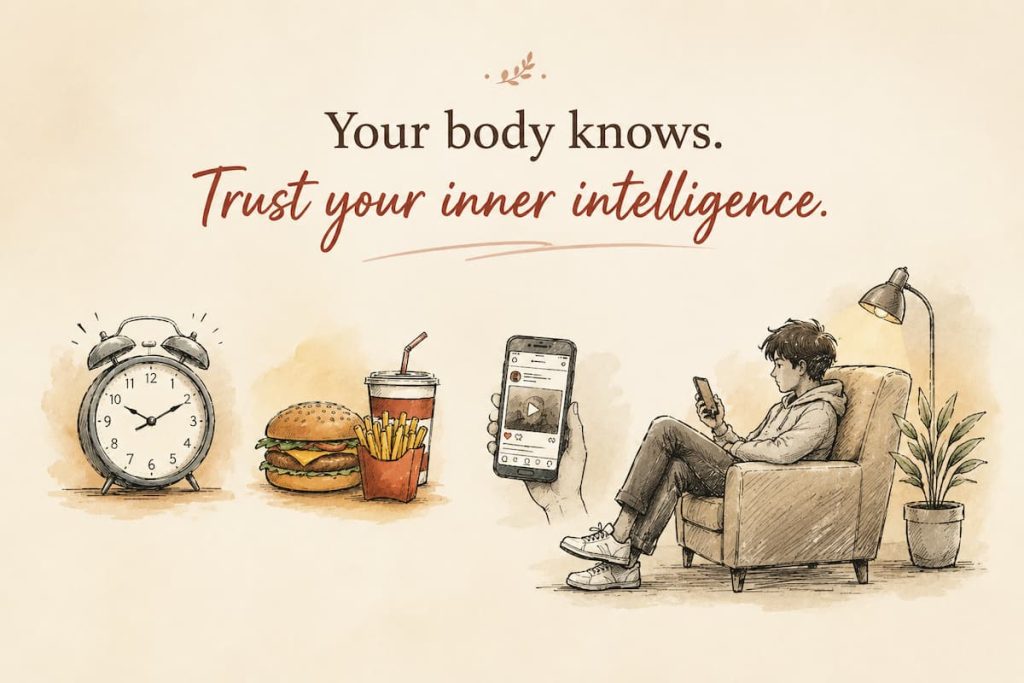
Most of us believe that disease begins in the body.
A pain appears.
Digestion becomes weak.
Sleep gets disturbed.
Energy levels drop.
But Ayurveda looks much deeper. Ayurveda explains that disease does not arise from a single cause. Classical Ayurvedic texts describe three fundamental causes of disease: Pragnya Aparadh (the misuse of intellect), Asatmyendriyartha Samyoga (improper use of the senses), and Parinama or Kala (the effects of time and seasonal changes). Among these, Pragnya Aparadh is considered especially significant because it influences the countless choices we make every single day—and those choices gradually shape our health.
According to Ayurveda, many diseases begin long before physical symptoms become noticeable. They often start with subtle imbalances that arise when we repeatedly ignore the body’s natural signals..
This tendency is called Pragnya Aparadh — the mistake of the intellect or an error in judgement despite knowing what is right.
Everyday Examples of Pragnya Aparadh
- Ignoring Fatigue – The body asks for rest. …we rely on stimulants like tea or coffee instead of adequate rest..
- Ignoring Digestion – The body signals discomfort. We continue eating foods that don’t suit us.
- Ignoring Movement – The body needs activity. We sit for hours.
- Ignoring Emotions – The body asks us to process anger, grief, and stress. We suppress them.
This gap between wisdom and action is what Ayurveda calls Pragnya Aparadh.
The Three Pillars of Inner Wisdom by Charaka
Thousands of years ago, Acharya Charaka described this concept beautifully:
धीधृतिस्मृतिविभ्रष्टः कर्म यत्कुरुतेऽशुभम् ।
प्रज्ञापराधं तं विद्यात् सर्वदोषप्रकोपणम् ॥
Dhidhriti Smriti Vibhrashtah Karma Yat Kurute Ashubham
Pragnya Aparadham Tam Vidyat Sarva Dosha Prakopanam
Meaning:
When a person’s intellect (Dhi), restraint (Dhriti), and memory (Smriti) become disturbed, they begin performing actions that are harmful to themselves. This is called Pragnya Aparadh, and it becomes the cause of imbalance in the doshas.
At its core, Pragnya Aparadh simply means: Knowing what is right, but doing otherwise.
It is not ignorance. It is knowing that something is harmful and still continuing to do it.
Ayurveda explains that our inner guidance depends upon three important faculties.
Dhi – The Power to Understand. Dhi is our ability to distinguish between what is beneficial and what is harmful. It helps us recognise:
- What foods suit us
- What habits strengthen us
- What activities drain us
- What choices maintain health and harmony.
When Dhi becomes clouded, we lose clarity and begin making poor decisions.
Dhriti – The Power of Self-Control – Knowing what is right is one thing. Following it consistently is another. Dhriti is the inner strength that helps us act according to what we know is good for us. It helps us resist unhealthy impulses and stay committed to healthier choices. Dhriti translates knowledge into action.
When Dhriti weakens, desires and habits begin to overpower wisdom.
Smriti – The Power of Remembering – Smriti is not merely memory. It is the ability to remember our experiences and learn from them. It helps us remember:
- What experiences have previously brought balance and healing.
- What created imbalance
- What our body has already taught us
When Smriti weakens, we keep repeating the same mistakes despite experiencing their consequences.
How Disease Begins?
Most diseases do not appear overnight. The body usually gives us many warning signs before illness develops. It may show up as:
- Poor digestion
- Disturbed sleep
- Fatigue
- Constipation
- Irritability
- Reduced flexibility
- Frequent aches and pains
These early warning signs are opportunities for correction. If recognised and addressed early, the progression towards disease can often be prevented. Instead of understanding and correcting the underlying cause, we often seek temporary relief from symptoms while continuing the same habits that created the imbalance in the first place. Over time, these small daily choices accumulate and eventually manifest as disease.
Ayurveda teaches that symptoms are often the final stage of a process that began much earlier.
Pragnya Aparadh in Modern Life
Today’s lifestyle provides countless examples of Pragnya Aparadh.
• We know movement is essential, yet many of us sit for hours.
• We know sleep is important, yet we sacrifice it regularly.
• We know stress affects health, yet we rarely slow down.
• We know highly processed and incompatible foods affect our well-being, yet they have become a part of daily life.
The challenge today is not a lack of information. In fact, we have more health information available than ever before. Yet, in the midst of all this information, many of us have become disconnected from ourselves.
We often look to social media influencers, health trends, viral advice, and the latest wellness fads to tell us what is right for us, while paying less attention to what our own body is trying to communicate. Instead of observing our sleep, digestion, energy levels, emotions, and overall sense of well-being, we increasingly depend on external opinions and recommendations.
Ayurveda reminds us that true health begins with awareness. Our body is constantly communicating through hunger, thirst, sleep, digestion, energy, emotions, and even pain. The question is not whether the body is speaking; the question is whether we are listening.
When we learn to reconnect with our body’s inner intelligence and trust the wisdom already present within us, we take the first step towards preventing Pragnya Aparadh and restoring balance.
In the next article, we will explore how Kumbhak and traditional Kriya practices help us develop this awareness and reconnect with the body’s natural intelligence.




5 Comments
Such a thought provoking piece Neena ma’am! We know what is right, yet we continue to err and ignore the signals our body gives. I hope we can make amends and regain our lost health.
I wish this knowledge can be shared with the younger generation too. I hope they shall wake up sooner than later. God bless you for making us aware and encouraging us to align with nature and balance 🙏☺️🙏
Yes I belief it all starts with digestion the food we put in. How organic is it? Kumbak leads us to it. Holistic healing should be our approach to leading a healthy productive life and inner well being.
Read the article.The everyday pradnya aparadha mentioned in it are 100% correct.We must make aware the present young generation about same.
Pradnya Aparadha, first time I’ve read this phrase. It’s implications are so apt. Very well informed and well explained article.
मुझे प्रज्ञा अपराध के सारे में पहले कोई जाणकारी नहीं थी . भोजन ,पाचन के बारे में ज्ञात था।आर्टिकल ने नयी जानकारी प्रदान की