

Part 1 of the Swar Vigyan(Science of Breath) Series
चले वाते चलं चित्तं निश्चले निश्चलं भवेत् ।
योगी स्थाणुत्वमाप्नोति ततो वायुं निरोधयेत् ॥ २ ॥
“When the breath moves, the mind moves; when the breath becomes still, the mind becomes still.” — Hatha Pradipika, Chapter 2, Verse 2 by Swami Svatmarama
The practices of breath and kumbhak have their roots in an ancient yogic and Ayurvedic experiential tradition, preserved through generations and later recorded in classical texts.
We all breathe. But how often do we actually notice our breath?
Breathing is something we do every moment of our lives, usually without giving it a second thought. But pause for a moment. Don’t change your breath. Just notice it.
Which nostril is more active right now—the left or the right?
You may be surprised to discover that the breath does not always flow equally through both nostrils. One nostril may feel more open while the other feels less active. And after some time, this may change.
This changing flow of breath is what the ancient yogic tradition invites us to observe through Swar Vigyan—the science of breath flow.
Your Breath Has a Rhythm
In the traditional yogic understanding, the breath is closely connected with Prana, the vital life force. And the flow of Prana is described through subtle pathways known as Nadis.
Of these, three are especially important: Ida, Pingala and Sushumna.
Ida is traditionally associated with the left nostril and the moon, while Pingala is associated with the right nostril and the sun. They represent two complementary qualities within us.
Neither is better than the other. We need both. There are times when we need action, focus and outward engagement, and times when we need rest, recovery and inward attention.
Balance is not about remaining permanently in one state. It is about having the capacity to move appropriately between complementary states.
And Then There Is Sushumna
Alongside Ida and Pingala, yogic texts describe Sushumna as the central subtle pathway. In the traditional yogic framework, it is associated with the central axis, greater equilibrium, inner awareness and deeper meditative states. Traditional yogic understanding associates periods of more balanced breath flow with Sushumna and a state of greater equilibrium,
When the breath is experienced as flowing more evenly through both nostrils, yogic tradition associates this with a more balanced state and with Sushumna. This is not something a beginner needs to force. The more useful starting point is awareness: observe the breath, notice its changing flow, and gradually learn how breath practices are used to cultivate balance.
The Breath–Mind Connection
Think about what happens when you are stressed. Your breath may become faster. Your body may become tense. Your thoughts may start racing.
Now think about a moment when you felt completely relaxed. The breath often becomes quieter. The body softens. The mind becomes less restless.
The ancient yogic observation is beautifully simple: watch the breath, and you begin to notice the mind. The breath is automatic—but we can also become conscious of it. That small shift is important. Instead of simply breathing, we begin to notice how we are breathing.
This Is Where Our Practice Begins
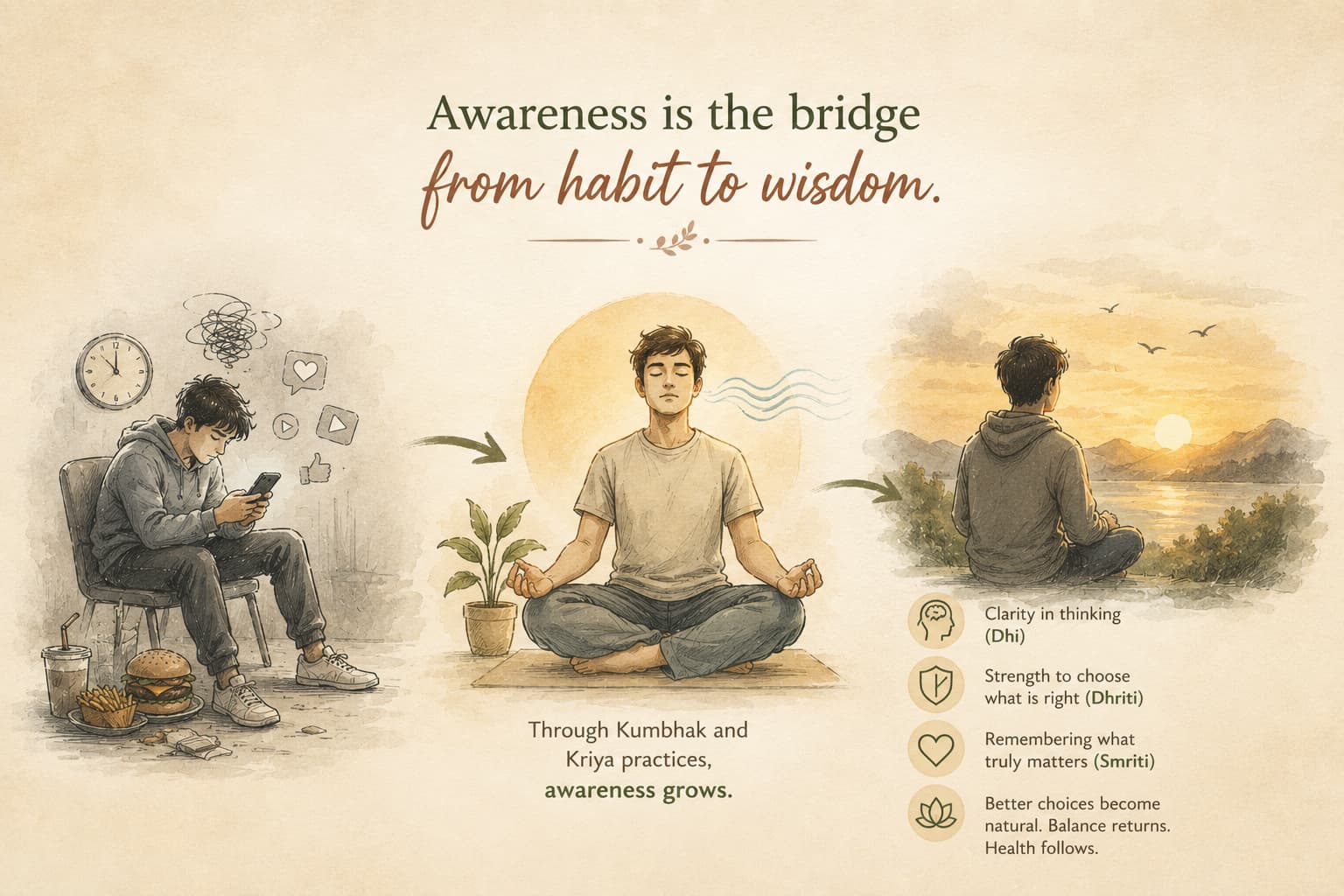
At Avisa, awareness is an important part of our practices. We don’t simply move the body—we bring attention to the body. We don’t simply breathe—we learn to observe the breath.
We use specific focal points, specialised movements and breath practices to gradually develop greater awareness of the body, breath and internal state.. As we become more aware of the body, the breath and our internal state, we begin to understand ourselves differently.
From Breath Awareness to Nadi Shodhan
Once you begin observing the breath, the next question naturally arises: Can we consciously work with it?
This brings us to Nadi Shodhan. In the yogic framework, Nadi refers to a subtle pathway and Shodhan means purification or cleansing.
Through conscious breathing practices, we begin to work with the breath rather than simply allowing it to remain unconscious. Our first Nadi Shodhan practices introduce this idea of balance through the breath and prepare us progressively for deeper practices.
TRY THIS TODAY
The next time you feel rushed, restless, tired or mentally scattered, don’t immediately try to change anything. Pause. Observe your breath. Notice your nostrils. Notice your body. Notice your mind. Just observe.Awareness is the first step towards balance.
A Breath Worth Paying Attention To
Your breath is always with you, yet we rarely pay attention to it. Perhaps the journey of conscious breathing begins with something as simple as noticing what is already happening.
The next time you breathe… pause and pay attention.
Coming Next: Part 2
What Is Your Breath Telling You? In the next part of our Swar Vigyan series, we will take a closer look at Ida, Pingala and Sushumna.
Why does one nostril become more active than the other? What do the left and right flows traditionally represent? And how can simply observing your Swar become a practical tool for greater awareness and well-being?





4 Comments
Very useful knowledge. From now onwards i will try to pay attention to breathing. Thanks a lot for sharing such wisdom. Waiting for next part.
Very useful knowledge for our daily breathing practices and life. It looks simple but there is a lot of depth in it. Thank you.
Very useful information.breath is life
अच्छा लग रहा है। पूरा समझ मे नही आ रहा। हिंदी मे भी हो तो हम बहुत मदद मिलेगी। धन्यवाद