
Part 1 of the Swar Vigyan(Science of Breath) Series
Have you ever noticed that some days you feel energetic, focused and ready to take on anything, while on other days you feel quieter, slower or more inward? Our state changes constantly—and traditionally, Swar Vigyan invites us to notice one simple rhythm that accompanies these changes: the flow of the breath through the nostrils.
Instead of asking you to analyse your breath all day, begin with something much simpler: notice how you feel. Then notice which nostril is naturally more open. With practice, this becomes a fascinating way of understanding the relationship between breath, state and activity.
“Breath is the vehicle of consciousness.”
— B.K.S. Iyengar
Perhaps this is why breath awareness is such an important doorway into our practices. The breath gives us something tangible to notice—and through that noticing, we begin to become more aware of ourselves.
Two Nostrils, Two Different Qualities
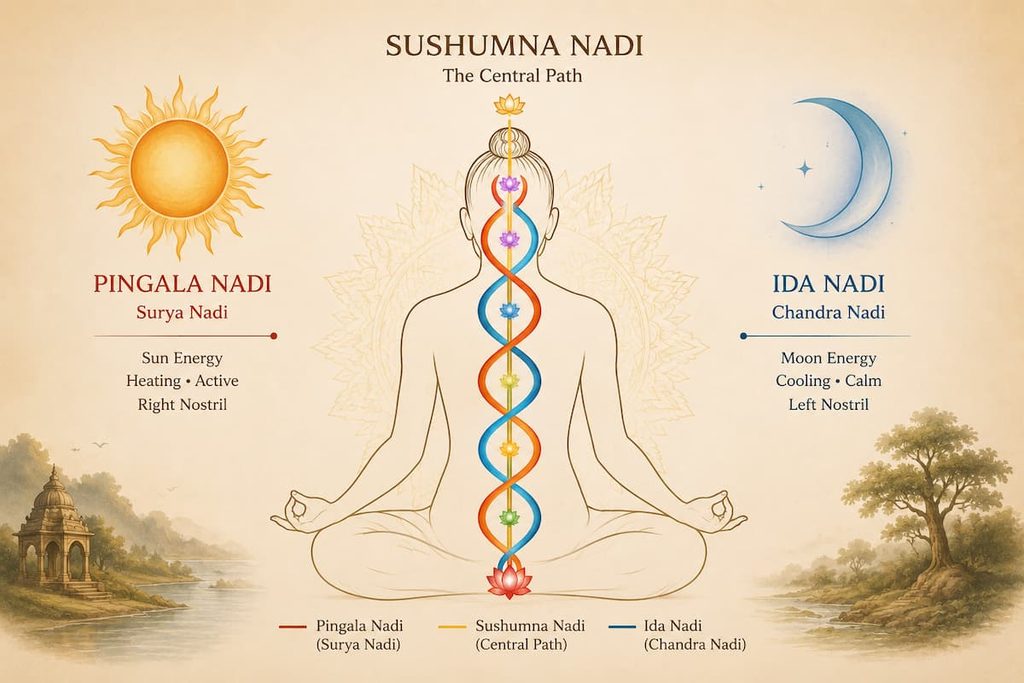
In the traditional understanding of Swar Vigyan, the breath naturally alternates between the left and right nostrils. The two flows are associated with Ida (Chandra) and Pingala (Surya), each representing a different quality of pranic activity. Neither is considered good or bad. The emphasis is on recognising the quality that is present and cultivating balance.
| Left Nostril • Ida / Chandra | Right Nostril • Pingala / Surya | Balanced Flow • Sushumna |
| Cooling, calming, receptive | Heating, active, stimulating | Stillness, balance, inward awareness |
| Traditionally associated with the moon | Traditionally associated with the sun | Associated with the central pathway |
| Rest, creativity, reflection | Action, focus, physical activity | Meditation and deeper awareness |
| A quieter, more inward quality | A dynamic, outward-moving quality | A neutral, centred quality |
These descriptions are part of the traditional language of Swar Vigyan. They are best understood experientially—not as labels to judge ourselves by, but as qualities to observe.
Before You Change Anything, Notice the Difference
The most useful place to begin is not by trying to control the breath. It is by noticing what is already happening.
When you feel active and ready to act — Notice whether the right nostril feels more open. Traditionally, this is associated with Pingala or Surya—the more dynamic, heating and action-oriented quality.
When you feel calm, reflective or inward — Notice whether the left nostril feels more open. Traditionally, this is associated with Ida or Chandra—the cooling, receptive and calming quality.
When both nostrils feel relatively open — Notice the quiet balance. This is traditionally associated with Sushumna and is considered especially suitable for meditation, prayer and inward awareness.
What If One Nostril Feels Blocked?
This is one of the most common questions participants have during practice. A nostril may feel less open because of posture, congestion or simply the natural variation in nasal airflow. There is no need to force the breath through it.
If you want to gently encourage a change in the airflow, traditional practice offers a few simple approaches:
- To encourage the right nostril to open, lie comfortably on your left side for a few minutes.
- To encourage the left nostril to open, lie comfortably on your right side for a few minutes.
- You may also change your posture and observe whether the airflow naturally shifts.
- During formal practice, follow the specific method taught by your qualified yoga teacher rather than forcing a particular nostril to open.
A simple rule: gentle awareness, never force. If the nose is genuinely congested, breathe comfortably and do not strain.
How Did Traditional Practitioners Use Swar?
Swar Vigyan was not only about observing the breath during meditation. Traditional teachings also explored how the active swar could be considered while approaching everyday activities.
For example, the right or Surya swar was traditionally associated with more active functions such as eating and physical or purposeful work, while the left or Chandra swar was associated with calmer, receptive and creative activities. When both nostrils were flowing evenly, the emphasis shifted towards stillness, contemplation and spiritual practice.
You do not need to reorganise your entire day around your nostrils. Instead, treat this as an invitation to experiment gently: notice the breath before an activity and see whether the quality of your experience changes when you become more aware of it.
Ancient Wisdom Meets Modern Research
This is where an interesting bridge begins to appear between traditional practice and modern research. Researchers are exploring whether breathing through different nostrils may be associated with changes in patterns of brain activity. Some preliminary imaging studies have reported differences in brain activity during left- and right-nostril breathing, although the findings are still being investigated and do not, by themselves, establish a direct scientific equivalent to the traditional understanding of Ida and Pingala.
Alternate-nostril breathing has also been studied for its possible role in stress regulation and relaxation. Some studies have reported changes in measures related to autonomic activity, emotional regulation and, in some cases, cortisol levels. However, research in this area is still developing, and the findings should be understood as emerging evidence rather than definitive scientific validation of traditional claims. Even so, this growing body of research offers an interesting modern perspective on why rhythmic breathing practices such as Nadi Shodhana may be experienced as calming, centering and balancing.
For us, this makes Nadi Shodhana especially meaningful. We are not trying to prove a scientific theory or equate modern research findings with the traditional framework of Swar Vigyan. Rather, we are bringing an ancient, experiential practice into our own experience and observing how a steady rhythm of breath may influence the way we feel, focus and respond.
Try This Today
The next time you notice a strong change in how you feel—energised, tired, restless, calm or inward—pause for just a few seconds.
- Notice which nostril feels more open.
- Notice how your body feels.
- Notice the quality of your mind.
- Take a few natural, unforced breaths.
- Then continue with your activity.
There is no right answer to discover. The practice is simply to become curious about the connection between breath and your experience.
The Beginning of a Deeper Practice
Swar Vigyan becomes meaningful when it moves from something we have read about to something we begin to experience. The breath is constantly changing, and so are we. Learning to recognise that rhythm can bring a new quality of awareness to our everyday lives and to our yoga practice.
Coming Next: Part 3
In the next article, we move from the breath to another important dimension of our practice — the spine.
Why does the spine matter? What is Merudanda? And what is meant by the Central Path?
We’ll explore the traditional understanding of the spine as an important axis of the body, and its connection with breath, movement, stability and deeper awareness.



One Comment
Really grateful for these detailed informative articles. Knowing WHY we do a particular act of pranayam or yoga makes it so much more relevent and meaningfull. Looking forward to more such information. Thank you Neena.