Merudanda and the Central Path | Swar Vigyan Series · Part 3
समं कायशिरोग्रीवं धारयन्नचलं स्थिरः ।
सम्प्रेक्ष्य नासिकाग्रं स्वं दिशश्चानवलोकयन् ॥ ६.१३ ॥
— श्रीमद्भगवद्गीता, अध्याय ६, श्लोक १३
‘Samam Kaya Shiro Grivam Dharayann Achalam Sthirah Samprekshya Nasikagram Svam Dishash Chanavalokayan ‘
Keeping the body, head and neck aligned, steady and still, and directing the gaze towards the tip of the nose without looking around.
Such a simple instruction, isn’t it? Sit steadily. Keep the head, neck and body aligned. But why would a text on meditation give so much attention to the way we sit?
Think about your own day. Perhaps you are reading this on your phone, leaning over a laptop, or relaxing on the sofa. Without noticing, your shoulders have rounded and your head has moved forward. Now gently sit a little taller, let your shoulders soften, and take one comfortable breath. Does anything feel different?
You may notice a little more room to breathe. Or perhaps you simply feel more aware of how you are sitting. That small observation is a lovely place to begin our exploration of Merudanda.
Merudanda: More Than “Sit Straight”
Merudanda is the Sanskrit name for the spinal axis. Physically, our spine supports the body, protects the spinal cord and allows us to move with flexibility. In yoga, it also holds a special significance as the foundation for steadiness, breath and inward awareness.
Remember the Bhagavad Gita verse we began with? Its message is beautifully simple: sit upright, but comfortably. Steadiness does not mean stiffness.
When we sit with a comfortably aligned spine, rather than slouching or holding ourselves rigidly, our chest and abdomen have greater freedom to move as we breathe. And remember, there is no single perfect posture for everyone. A cushion, a chair or suitable back support can be equally helpful.
And What Is the “Central Path”?
Now comes an interesting concept from yogic tradition: Sushumna Nadi. Yogic texts describe Sushumna as a subtle central pathway associated with the spinal axis, extending from the base upwards. It is considered an important pathway for the movement of prana and the development of deeper awareness.
Unlike the physical spinal cord, Sushumna belongs to the subtle-body understanding of yoga. Along this central pathway, yogic teachings also describe various energy centres known as chakras. So what is the significance of these centres, and how do they relate to our practices? Let us explore.
The Spine: Where Ancient Wisdom Meets Modern Understanding
Ancient yoga and modern anatomy offer two different yet interesting perspectives on our body.Modern science explains how our muscles, nerves and skeletal structures work together to support movement, posture and communication between the brain and body. Yoga takes us a step further into our inner experience. It encourages us to observe how our posture, breath and attention influence the way we feel.
Similarly, while chakras are traditionally described as centres of subtle energy, they are sometimes compared with nerve plexuses or endocrine glands because of their general locations. These comparisons can help us visualise the traditional concepts, although they are not scientifically established anatomical equivalents.
And this is where the beauty of practice comes in. When we sit comfortably, breathe with awareness and allow the body to settle, we may experience a sense of ease, balance and calmness. Sometimes, understanding begins not just with what we read, but with what we experience through practice.
The Seven Chakras: A Traditional Map of Inner Awareness
Imagine travelling gently from the base of the spine towards the crown of the head. In the commonly taught seven-chakra model, the journey is described like this:
| Traditional chakra | Region | Traditional association |
| Muladhara | Base of spine | Grounding and stability |
| Svadhisthana | Pelvic region | Fluidity and creativity |
| Manipura | Upper abdomen / solar plexus | Vitality and will |
| Anahata | Chest / heart region | Compassion and connection |
| Vishuddha | Throat | Expression |
| Ajna | Between the eyebrows | Insight and attention |
| Sahasrara | Crown of head | Higher awareness |
These are traditional associations, not medical descriptions or diagnostic markers. Different yogic lineages may explain them somewhat differently. For us as practitioners, the value lies in how this map encourages us to bring awareness to the whole body rather than focusing only on a single part.
The Three Granthis: Understanding the Inner Knots
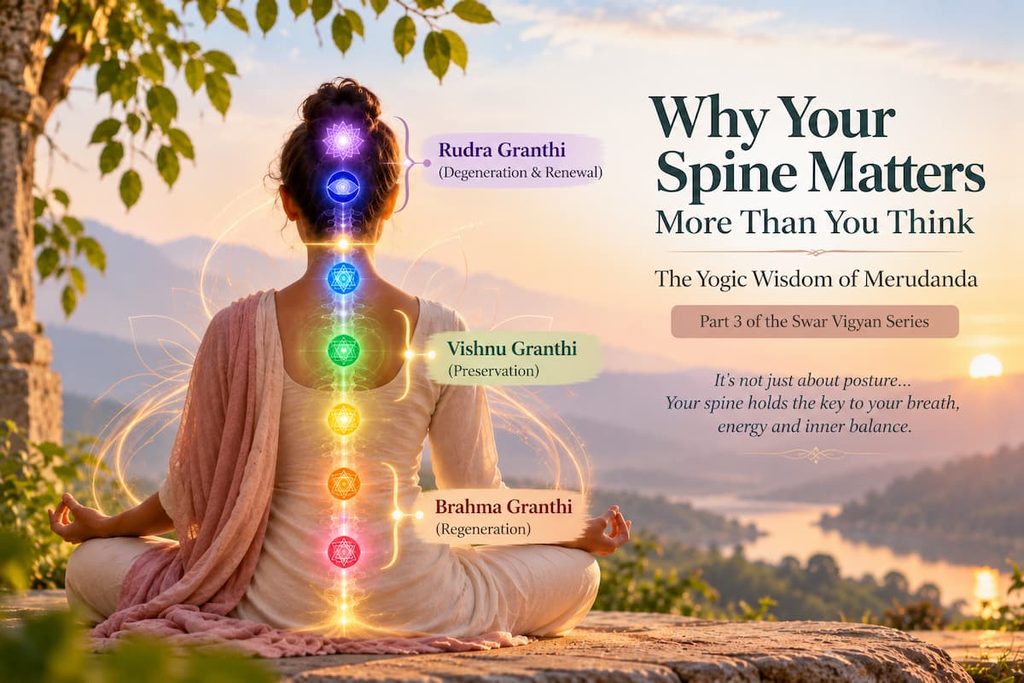
In the traditional yogic understanding, the Sushumna Nadi, described as the central subtle pathway running along the spine, is associated with three subtle knots known as Brahma Granthi, Vishnu Granthi and Rudra Granthi. At AVISA, these are also explored through the lens of three essential processes of the body: regeneration, preservation and degeneration. Brahma Granthi relates to regeneration, Vishnu Granthi to preservation, and Rudra Granthi to degeneration—the process through which the body breaks down and releases what is no longer needed. For optimal functioning, these processes must work in the right proportion, allowing the body to renew, maintain and transform itself.
Certain kriyas and bandhas are traditionally used in Granthi Bhed practices to work with these subtle knots. This understanding comes alive through Granthi Bhed Hatha Kumbhak, a powerful practice taught in Ashtanga Chikitsa, AVISA’s flagship programme, rooted in Swamy Sri RajVibhuji’s Kumbhak Kriya tradition. For participants who practise it, this offers a deeper perspective on its purpose; for those discovering it for the first time, it opens a window into another dimension of the work we do—one that engages with the physical body as well as the emotional and mental dimensions of well-being.
Why We Begin at the Base
Think of a tree. We admire its branches and leaves, but its steadiness begins with the roots. Our approach to practice at AVISA Healing & Fitness follows a similar principle.
We begin by establishing stability and awareness at the base of the spine—the Mula—and gradually build our practice upwards. Posture, gentle movement, breath and attention are not treated as separate pieces. They come together, step by step.
This is the intention behind the sequence, rather than a claim that every practice physically strengthens a particular muscle or that energy centres have been medically measured. It is a way of practising with care: first find your base, then explore what becomes possible from there.
And that is why we keep returning to two simple companions in practice: your breath and your spine. Not because they promise a cure for every condition, but because paying attention to them gives us an accessible starting point for working with our body and mind.
Try This for One Minute
Before your next practice, sit in a way that feels supported. Notice where your pelvis meets the seat and where your head rests over your neck. Allow your spine to lengthen gently, without arching or forcing. Relax your jaw and shoulders.
Now take three easy, natural breaths. Do not hold the breath or try to make it unusually deep. Simply observe: Does breathing feel more comfortable? Are you sitting with less effort? Is your attention a little less scattered?
There is no right sensation to achieve. If sitting upright causes discomfort, adjust your position or use support. The purpose is awareness, not perfection.
From the Spine to the Breath
Perhaps the most useful lesson here is also the simplest: how we sit and how we breathe are connected. Traditional yoga gives this relationship a rich language through Merudanda, Muladhara and Sushumna. Our everyday experience gives us a chance to explore it gently, one breath at a time.
And now for a curious observation: have you ever noticed that one nostril sometimes feels more open than the other? That natural variation leads us beautifully into the next part of our Swar Vigyan journey.
Next in the series: Nadi Shodhan — Exploring Ida, Pingala and the Breath – We will explore how this traditional practice invites us to observe our breathing and develop greater awareness of its natural variations.